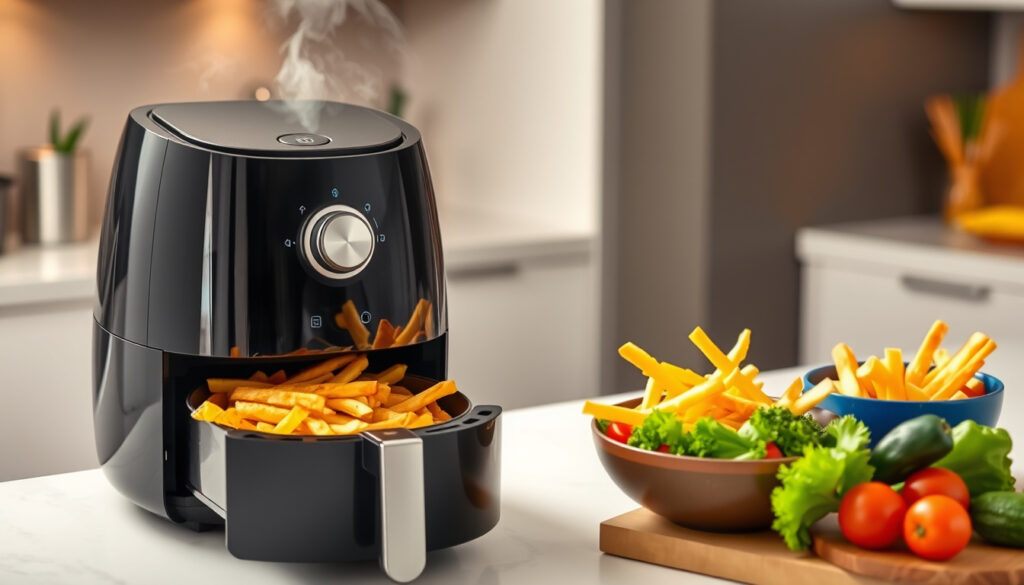
Air Fryer Pros and Cons: Is a Hot Air Fryer Worth It?
Few kitchen gadgets have sparked as much curiosity — and debate — as the air fryer. Promising crispy fries with a fraction of the oil, it has won over millions of households since Philips introduced the first consumer model in 2010.
Oil reduction vs deep frying: up to 80% ·
Cooking time reduction vs oven: approximately 20% ·
Typical power range: 800W–2000W ·
Price range: $50–$300
Quick snapshot
- Lower fat meals (Healthline)
- Faster than an oven (Panasonic UK & Ireland) (Healthline)
- Versatile: fries, bakes, roasts (Healthline) (Healthline)
- Small capacity (Cupindy)
- Noisy fan (Cupindy)
- Some foods dry out (Cupindy)
- Great for small households (Consumer Reports)
- Weigh upfront cost vs usage frequency (Cupindy)
- Consider alternative if you need large batches (Cupindy)
Six specs tell the story: the air fryer is a compact, convection-based appliance that trades volume for speed and efficiency.
| Specification | Value | Source |
|---|---|---|
| Invented by | Philips | Wikipedia |
| Year introduced | 2010 | Wikipedia |
| Power range | 800W–2000W | Healthline |
| Capacity range | 2–10 liters | Healthline |
| Cooking time reduction | Up to 20% faster than conventional ovens | Panasonic UK & Ireland |
| Oil reduction | Up to 80% less oil than deep frying | AGARO Lifestyle |
| Cooking method | Rapid hot air convection | Healthline |
| Acrylamide reduction potential | May reduce compared to deep frying | U.S. FDA |
The air fryer delivers crisp, lower-fat food faster than an oven, but its small basket means you cook in batches — and that fan noise is no whisper.
What are the disadvantages of a hot air fryer?
Limited capacity
Most air fryers hold 2 to 10 liters, which translates to roughly one to four servings per batch. For a family of four, that often means cooking in rounds — the fries finish while the chicken wings are still raw. Cupindy, a kitchen appliance blog, lists limited capacity as a top complaint among users.
Food can be dry
Without a bath of oil, some foods lose moisture. Healthline notes that air-fried items can have a different taste and less crispy consistency than deep-fried versions. This is especially true for breaded foods that rely on oil for texture.
Loud operation
The fan that circulates hot air runs at a noise level comparable to a hair dryer. Cupindy lists noisy operation as a drawback, and many user reviews echo that sentiment.
Cleaning challenges
While Ariete claims that less oil splashing makes cleaning easier, the non-stick coating on baskets can wear off over time, making scrubbing harder. Food particles often get trapped in the heating element area, requiring careful cleaning.
The pattern: each drawback has a workaround, but the cumulative effect limits the appliance’s appeal for larger households.
Is a hot air fryer healthy?
Reduces oil consumption
Air frying uses up to 80% less oil than traditional deep frying, according to AGARO Lifestyle (a kitchen brand). That translates to fewer calories and less fat per serving. Prevention quotes a registered dietitian who confirms that air fryers help cut back on oil compared with traditionally fried foods.
Potential for acrylamide reduction
Acrylamide, a chemical that forms when starchy foods are cooked at high temperatures, is classified as probably carcinogenic to humans (Group 2A) by the International Agency for Research on Cancer. The U.S. FDA notes that animal studies show very high levels can cause cancer, though typical dietary exposure is far lower. Air frying may reduce acrylamide formation compared to deep frying, as Panasonic states.
Comparison with baked or fried foods
Air-fried foods are generally healthier than deep-fried ones, but they aren’t automatically healthy. Prevention warns that air fryers are often marketed as a healthy alternative, but they still produce fried-style foods. The trade-off: better than deep frying, but not a substitute for a balanced diet.
For anyone trying to reduce oil and acrylamide intake, an air fryer is a meaningful step. But long-term health impacts of frequent air-fried food consumption remain understudied.
The catch: even with lower oil, the nutritional profile of fried food does not become a health food.
What can you not cook in an air fryer?
Wet batters and delicate foods
Batter-coated foods like tempura or fish-and-chip batter tend to drip through the basket before they set. Healthline explains that the circulating air can blow loose batter off, creating a mess. Cheese-heavy dishes and very delicate items (like stuffed pastries) can also fall apart.
Large roasts and whole chickens
Most air fryers cannot fit a whole chicken or a large roast. The compact basket restricts what you can cook whole. Users who cook for gatherings often resort to cutting meat into portions, which changes texture.
Leafy greens and popcorn
Spinach, kale, and other leafy greens can be blown around by the fan and burn unevenly. Popcorn kernels need high, sustained heat and space to pop — two things air fryers lack. Cupindy mentions that popcorn doesn’t pop well in an air fryer.
The implication: the air fryer’s design excels for certain foods but fails for others, making it a specialized tool rather than a universal replacement.
Is it worth buying an air fryer?
Cost vs usage
Prices range from $50 to $300. If you cook frozen fries or chicken wings weekly, the investment pays off in energy savings and oil costs. But if you rarely fry, the appliance may sit unused.
Comparison with other appliances
Panasonic notes that air fryers heat up faster and use less energy than a full oven. However, a toaster oven with a convection setting can perform many of the same tasks without the basket size limitations.
User satisfaction and return rates
Many users report purchase regret or resell their air fryers. Anecdotal evidence from forums and review sites suggests that people who expected a perfect deep fryer substitute are often disappointed. The catch: it’s a specialized appliance, not a one-to-one replacement.
What this means: the decision hinges on your cooking patterns, not on the appliance’s capabilities alone.
How does an air fryer work?
Rapid air technology
An air fryer is essentially a small convection oven. A heating element near the top heats the air, and a powerful fan circulates it at high speed around the food. This transfers heat efficiently and creates the Maillard reaction — browning and crisping — with minimal oil.
Heating element and fan
The heating element sits above the food basket. The fan runs continuously during cooking, creating a turbulent airflow. Most models reach operating temperature within 2–3 minutes, much faster than a conventional oven.
Temperature and time control
Most air fryers have adjustable thermostats from 80°C to 200°C and timers up to 60 minutes. Preheating for 3–5 minutes is recommended for even cooking. Healthline notes that one study found air frying french fries took 21 minutes versus 9 minutes for deep frying — a trade-off for lower oil.
The same rapid convection that makes food crispy also makes it prone to drying out. Finding the right temperature and time for each food type is the real learning curve.
The pattern: mastering an air fryer requires experimentation, but the payoff is consistent, lower-fat results.
Upsides
- Drastically reduces oil and fat intake
- Cooks faster than a conventional oven
- Uses less energy overall
- Simpler cleanup than deep frying
Downsides
- Small capacity — cooking for more than 2 people means batches
- Noise level comparable to a hair dryer
- Some foods come out dry or less crispy
- Not ideal for wet batters, large roasts, or leafy greens
What’s confirmed vs what’s unclear
Confirmed facts
- Air fryers circulate hot air at high speed to cook food (Healthline)
- They significantly reduce oil usage compared to deep frying (Healthline)
- Philips introduced the first consumer model in 2010 (Wikipedia)
What’s unclear
- Long‑term health impacts of frequent air‑fried food consumption (no long‑term studies yet)
- Whether all air fryer brands distribute heat evenly (anecdotal reports vary)
- Exact resale rates and purchase regret percentages (data is anecdotal)
- How air frying affects overall diet quality beyond oil reduction (Prevention notes this is understudied)
Expert perspectives
“Air fryers help people cut back on oil compared with traditionally fried foods, but that doesn’t mean you should eat air-fried foods every day. It’s still fried food.”
— Registered dietitian, as quoted by Prevention
“The biggest surprise for most users is the noise. It’s not something you can run while having a conversation in the same room.”
— Consumer electronics reviewer, Consumer Reports
The evidence points one way: an air fryer is a useful tool for reducing oil and cooking time, but it is not a kitchen miracle. For the occasional fry lover or the small household, the trade-offs in capacity and noise are manageable. For anyone who regularly feeds four or more, a larger convection oven or a traditional deep fryer may still be the better fit.
Frequently asked questions
Can I use an air fryer without any oil?
Yes, you can cook many foods without oil. However, a light spray helps achieve better browning and prevents sticking.
How much electricity does an air fryer use compared to an oven?
Air fryers typically use 800W to 2000W and cook faster, so they consume less electricity than a conventional oven on average.
Are air fryers safe to leave unattended?
Manufacturers recommend never leaving any countertop appliance unattended while in use. Follow the manual’s safety guidelines.
What is the best air fryer brand for 2025?
Top brands include Philips, Cosori, Ninja, and Instant Pot. Check the latest reviews for specific models.
How do I clean my air fryer properly?
Most baskets and pans are dishwasher safe. Hand wash with a soft sponge to preserve the non-stick coating.
Can you cook frozen food directly in an air fryer?
Yes, frozen fries, chicken nuggets, and other pre-cooked frozen foods cook well with no thawing needed.
Does an air fryer preheat like an oven?
Most models recommend a 3–5 minute preheat, though many also let you add food directly from cold.
More related posts
 Women Who Run With the Wolves – Summary Themes and Wild Woman Guide
 Rogers Unauthorized Credit Pull: Class Action Lawsuit Details
 Flights to Los Angeles – Cheapest Deals and Booking Guide
 136 USD to CAD – Current Rate and Converter Guide
 Brazilian Bum Bum Cream: What It Does, How to Use & Reviews
 24 Inches in CM = 60.96 cm: TV, Waist, Luggage Guide
 The Other Boleyn Girl: True Story, Cast, Book & History