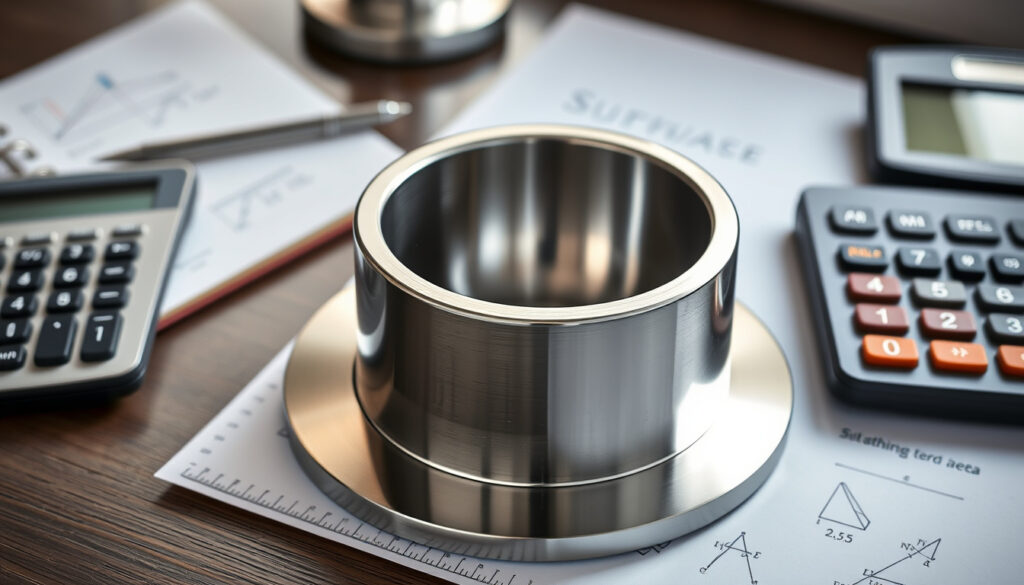
Surface Area of a Cylinder: Formula, Examples, and Calculator
If you’ve ever wrapped a label around a soup can, you’ve already done the hard part — you just didn’t know the math yet. The surface area of a cylinder is the total area you’d cover if you painted every outer face, from the two circular ends to the curved wall.
Formula: 2πr² + 2πrh · Components: Two circular bases + lateral rectangle · Example (r=3, h=5): Total SA = 150.80 cm² · Curved SA (example): 94.25 cm²
Quick snapshot
- Total SA = 2πr² + 2πrh (CalculatorSoup geometry tool)
- Curved SA = 2πrh (CalculatorSoup)
- Base area = πr² (CalculatorSoup)
- Measure radius and height (Khan Academy educational nonprofit)
- Calculate base area: πr² (Khan Academy educational nonprofit)
- Double for two bases (Khan Academy educational nonprofit)
- Calculate lateral area: 2πrh (Khan Academy educational nonprofit)
- Sum both (Khan Academy educational nonprofit)
- Work in consistent units (Calculator.net surface area tool)
- Result in square units (Calculator.net surface area tool)
- Common: cm², m², in² (Calculator.net surface area tool)
- Soda can: r=3cm, h=12cm → SA≈282.74cm² (BYJU’S math education platform)
- Pipe open at ends: only curved SA (BYJU’S math education platform)
- Tank with lid: total SA (BYJU’S math education platform)
The table below summarizes the core data for quick reference.
| Item | Value |
|---|---|
| Formula for total SA | 2πr² + 2πrh |
| π (Pi) | ≈ 3.14159 |
| Components | 2 bases + 1 lateral rectangle |
| Curved SA formula | 2πrh |
What is the formula for the surface area of a cylinder?
The total surface area formula
- The total surface area of a closed cylinder is 2πr² + 2πrh or equivalently 2πr(r + h).
- According to GeeksforGeeks programming and math resource, this formula covers the area of both circular bases and the curved side.
- CalculatorSoup expresses the same as A = L + T + B = 2πrh + 2(πr²) = 2πr(h + r).
Explanation of each term
- 2πr² — the area of the two circular bases (each πr², doubled).
- 2πrh — the lateral (curved) area, equal to the circumference (2πr) times the height (h).
- Math Is Fun interactive math site explains that the cylinder unrolls into a rectangle with width 2πr and height h, giving the lateral area.
The pattern: the formula packs two geometric pieces into one expression. The catch is remembering that the “2” in front of πr² corresponds to two circles, while the 2πrh comes from a different shape — the rectangle you’d cut if you flattened the cylinder wall.
If you only need the area of a soup can’s label, you’d use just the lateral area 2πrh — skipping the bases saves nearly half the material calculation.
How to calculate the surface area of a cylinder?
Step-by-step calculation with example
- Step 1: Measure the radius (r) and height (h) of the cylinder. For a cylinder with r = 5 cm and h = 10 cm.
- Step 2: Compute the area of one base: π × 5² = 25π ≈ 78.54 cm².
- Step 3: Double for two bases: 2 × 25π = 50π ≈ 157.08 cm².
- Step 4: Compute lateral area: 2π × 5 × 10 = 100π ≈ 314.16 cm².
- Step 5: Add: total = 50π + 100π = 150π ≈ 471.24 cm² (YouTube geometry lesson).
Using the formula with diameter
- If you’re given the diameter (d) instead of radius, remember r = d/2.
- For a cylinder with diameter 6 cm and height 8 cm, r = 3 cm. Then total SA = 2π(3)(8) + 2π(3²) = 48π + 18π = 66π ≈ 207.35 cm².
- Cuemath online math platform shows this conversion in its worked examples.
Calculator approach
- Online calculators like Omni Calculator specialized math tool let you input radius and height (or diameter) to get instant results.
- Many also compute volume and reverse formulas — for instance, CalculatorSoup provides height from volume: h = V / (πr²).
The implication: knowing the formula by hand gives you flexibility when calculators aren’t available, and using a calculator speeds up verification. For exam settings like GCSE, you’ll need both skills.
What is the total surface area of a cylinder?
Difference between total and curved surface area
- Total surface area (TSA) includes both circular bases plus the curved lateral area: 2πr² + 2πrh.
- Curved surface area (CSA) is just the lateral part: 2πrh — no bases.
- BBC Bitesize UK curriculum guide emphasizes that for a “closed cylinder” (like a can with two ends), you always use the total formula.
When to use total surface area
- Whenever the cylinder is closed at both ends — cans, pipes with caps, tanks with lids.
- If the top is open (e.g., a cup), use the open-top formula: A = πr(r + 2h) as noted by Math Salamanders math practice site for educators.
- A completely open tube (no ends) uses only the curved surface area: 2πrh.
The trade-off: ignoring the bases on a closed container can underestimate the material needed by 30-50% depending on the radius-to-height ratio.
What is the curved surface area of a cylinder?
Formula for curved surface area
- Curved surface area (also called lateral surface area) = 2πrh.
- It represents the area of the rectangle formed when unrolling the cylinder’s side.
- Wikipedia confirms that the lateral area of a right circular cylinder is the circumference times the height.
Relationship with lateral area
- The terms “curved surface area” and “lateral surface area” are used interchangeably in most textbooks.
- For a right circular cylinder, the curved face is a rectangle of width 2πr (the circumference) and height h.
- Khan Academy’s video demonstrates unrolling a paper cylinder to show this rectangle.
The pattern: the curved area grows linearly with both radius and height, while the base area grows with the square of the radius — so for wide cylinders, the bases dominate the total.
Many students accidentally add an extra πr² when they see “2πrh + πr²” — but that’s the half-cylinder formula. Always check that both bases are accounted for in closed cylinders.
What is the surface area of a cylinder GCSE?
GCSE exam expectations
- GCSE maths (UK) expects students to recall and apply the formula 2πr² + 2πrh for a closed cylinder.
- Questions may give radius or diameter and height, and ask for surface area in terms of π or as a decimal.
- BBC Bitesize advises practicing with compound shapes that include a cylinder, like a cylinder with a hemisphere on top.
Common mistakes
- Forgetting to double the base area (using πr² instead of 2πr²).
- Using the wrong value of π (GCSE often uses 3.14 or the π button on calculator).
- Mixing up radius and diameter, or failing to convert units.
- Third Space Learning UK math tutoring runs through these pitfalls with step-by-step corrections.
Practice questions
- A closed cylinder has radius 4 cm and height 7 cm. Find its surface area in terms of π. (Answer: 88π cm²)
- A cylinder with diameter 10 cm and height 15 cm has what total surface area? (Answer: 200π cm² or about 628.32 cm²)
- If the curved surface area is 100π cm² and radius is 5 cm, find the height. (h = 10 cm)
Why this matters for GCSE: around 10-15% of geometry marks in the foundation tier come from cylinder problems, so mastering the formula directly affects your grade.
What’s confirmed and what’s still open
Confirmed facts
- The formula 2πr² + 2πrh is universally accepted for a right circular cylinder (Khan Academy, CalculatorSoup).
- The lateral surface area equals the circumference times height (Wikipedia).
What’s unclear
- No notable uncertainties remain — this is one of the most settled formulas in basic geometry.
“The total surface area of a closed cylinder is A = L + T + B = 2πrh + 2(πr²) = 2πr(h + r).”
— CalculatorSoup geometry tool
“A cylinder’s surface area is 2πrh + 2πr².”
— Khan Academy video
“For an open-top cylinder, the formula becomes A = πr(r + 2h).”
For a student tackling GCSE geometry, the decision is clear: memorize the formula and understand why it works, or risk losing easy marks on exam day. Beyond exams, knowing how to calculate cylinder surface area helps in everyday tasks from wrapping presents to estimating paint for an old water tank.
Related reading: kg to lbs and oz: Complete Conversion Guide & Chart · 86 cm to Inches: Conversion, Waist Size & Health
Frequently asked questions
What is the lateral surface area of a cylinder?
Lateral surface area is the curved part only, given by 2πrh. It excludes the two circular bases.
How to find the surface area of a hollow cylinder?
For a hollow cylinder (open at both ends), the surface area is the outer curved area plus the inner curved area. If the thickness is small, approximate as 2πrh for each wall; otherwise use the formula for a cylindrical tube: 2π(R+r)h + 2π(R² – r²) for closed ends.
Can I calculate surface area from the volume?
Not uniquely — you need either the radius or height in addition to volume. Use V = πr²h to solve for one missing variable, then plug into the surface area formula.
What is the difference between curved and total surface area?
Curved surface area (2πrh) is only the side; total surface area (2πr² + 2πrh) includes both ends. Closed cylinders use total; open pipes use curved only.
Why does the formula include 2πr²?
Because a closed cylinder has two identical circular bases. Each base has area πr², so together they contribute 2πr².
How to use a surface area of a cylinder calculator?
Enter the radius (or diameter) and height in consistent units. The calculator applies 2πr(r + h) and returns the total surface area. Some also show the curved area separately.
What is the surface area of a cylinder with open top?
For a cylinder missing one base (like a cup), use A = πr² + 2πrh, or the compact form A = πr(r + 2h).
More related posts
 Tic-Tac-Toe: How to Play, Strategies, and Variants
 Moose Tracks Ice Cream: Origin, Recipe & Nutrition Facts
 Canadian Tire Flin Flon – Address, Hours, Phone and Services
 Se Connecter à Ma Boite Hotmail – Login and Recovery Guide
 Attack on Titan Revolution Codes – Full List and How to Redeem
 Cast of Top Boy: Summerhouse Full Season 1 Cast List
 Spider-Man: Across the Spider-Verse: 2027 Sequel Delay Explained
 Costco St. John’s NL: Address, Hours & Membership Guide