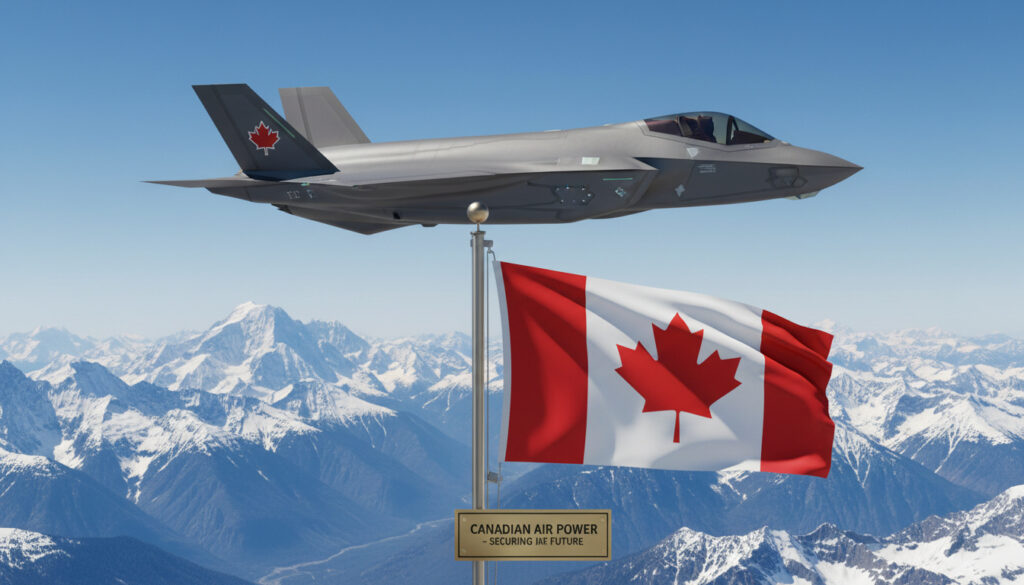
Canada Fighter Jet Competition – F-35 Selected, Timeline, Costs
Canada has initiated the most significant investment in its air force in over three decades through the Future Fighter Capability Project, selecting the F-35A Lightning II to replace its aging CF-18 Hornet fleet. The $19 billion procurement will deliver 88 advanced multi-role fighter jets designed to defend Canadian sovereignty, support North American Aerospace Defense Command operations, and fulfill NATO commitments through 2060.
The competition, launched in December 2017, originally attracted five major aerospace manufacturers but winnowed down to two finalists before the government announced its decision in January 2023. While the selection process has concluded, questions remain about delivery schedules, interim capabilities, and the specific industrial benefits flowing to Canadian companies.
Understanding which aircraft competed, why certain manufacturers withdrew, and how the technical evaluation distinguished between platforms provides essential context for this generational defense procurement.
Which Fighter Jets Competed in Canada’s Procurement?
Lockheed Martin
Status: Selected
Stealth, multi-role, 5th generation
Saab
Status: Finalist
Cost-effective, single-engine, Swedish design
Boeing
Status: Withdrawn Dec 2021
Carrier-capable, twin-engine
Dassault Aviation
Status: Withdrawn 2018
Delta-wing, French independent systems
- The competition began in December 2017 with five multinational aerospace corporations submitting proposals.
- Dassault Aviation withdrew in 2018 citing incompatibility with Five Eyes intelligence sharing requirements.
- Airbus exited in 2019 claiming the tender specifications favored the F-35 platform.
- Boeing’s Super Hornet was eliminated by December 2021, leaving only Saab and Lockheed Martin.
- Technical evaluations awarded the F-35 a score of 57.1 out of 60, while the Gripen received 19.7.
- The $19 billion contract covers 88 aircraft plus weapons, infrastructure, and sustainment services.
- Interim upgrades to existing CF-18s will maintain operational capability until the first F-35 arrives in 2026.
| Fact | Detail | Source Context |
|---|---|---|
| Selected Aircraft | F-35A Lightning II | Government announcement |
| Total Quantity | 88 fighter jets | FFCP procurement plan |
| Project Investment | $19 billion CAD | Parliamentary documentation |
| Competition Launch | December 2017 | Procurement records |
| Final Bidders | Saab Gripen E, Lockheed Martin F-35A | December 2021 shortlist |
| Selection Date | January 9, 2023 | Defence review |
| First Delivery | 2026 (expected) | Project timeline |
| Aircraft Replaced | CF-18 Hornet | Royal Canadian Air Force |
| F-35 Technical Score | 57.1/60 | Technical evaluation |
| Gripen Technical Score | 19.7/60 | Technical evaluation |
| Interim Capability | Hornet Extension Project | Phase 1 and 2 upgrades |
What Were the Key Requirements?
The Future Fighter Capability Project established mandatory operational requirements that all competing aircraft had to satisfy. These included defending Canadian airspace, protecting North America under NORAD command, and contributing to overseas coalition operations. The evaluation assessed capability, cost, and economic benefits, with particular attention to industrial and technological advantages for Canadian industry.
Why Did Some Manufacturers Withdraw?
Three major manufacturers exited the competition before the final selection. Dassault Aviation withdrew its Rafale in 2018, with CEO Eric Trappier explicitly citing security constraints related to Canada’s membership in the Five Eyes intelligence alliance. The French system’s independent architecture proved incompatible with integrated Western defense networks.
Airbus departed in 2019, arguing that tender terms appeared skewed in Lockheed Martin’s favor. By December 2021, Boeing’s Super Hornet was also eliminated, leaving only Saab and Lockheed Martin as eligible bidders.
Dassault Aviation explicitly cited Canada’s membership in the Five Eyes intelligence alliance as incompatible with Rafale procurement, as the French system operates independently of integrated Western defense networks. This withdrawal underscored the strategic importance of interoperability in the final selection.
Has Canada Selected a Winner?
Did Canada Choose the F-35?
On January 9, 2023, the Government of Canada announced it had reached an agreement with the U.S. government, Lockheed Martin, and Pratt & Whitney for the F-35A acquisition. This represents the most significant investment in the Royal Canadian Air Force in more than 30 years. The agreement covers 88 aircraft, associated equipment, weapons, infrastructure, and sustainment services.
Is the Competition Still Ongoing?
The competition has concluded. The finalization phase has been completed, with all assessments confirming the agreement meets Canada’s requirements for capability, cost, flexibility, risk mitigation, and economic benefits. National Defence conducted infrastructure assessments between 2018 and 2022 to define the requirements needed to support the future fighter fleet.
In rated requirements assessment, the F-35 achieved 57.1 points out of 60 possible, while the Gripen E scored 19.7. Both aircraft met mandatory operational requirements for defending Canada, North America, and contributing to overseas operations, but the evaluation revealed significant capability gaps between the fifth-generation stealth platform and its competitor.
What Is the Timeline for Delivery?
- : Government launches open competition to replace CF-18 fleet.
- : Dassault withdraws Rafale citing Five Eyes security constraints.
- : Airbus withdraws Eurofighter Typhoon alleging tender bias toward F-35.
- : Boeing eliminated; only Saab and Lockheed Martin remain eligible.
- : Canada announces F-35 selection and reaches agreement with U.S. government and manufacturers.
- : First F-35 delivery expected to Royal Canadian Air Force.
While awaiting F-35 deliveries, the Hornet Extension Project maintains operational capability. Phase 1 delivers enhancements for up to 94 CF-18 aircraft, addressing civilian air traffic management regulations and allied military interoperability. Phase 2 provides combat capability upgrades for 36 CF-18 aircraft to ensure mission-ready fighters until the F-35 fleet reaches full operational capability.
Why Is Canada Buying New Fighter Jets?
The CF-18 Hornet fleet has served since the 1980s and requires replacement to meet evolving threat environments. The F-35 will serve as a cornerstone for interoperability with NORAD and NATO, strengthening Canada’s operational capability with its allies. Local infrastructure developments supporting this project include facilities like Canadian Tire Flin Flon – Address, Hours, Phone and Services, which illustrates the type of community investment accompanying national defense spending.
What Is the Future Fighter Capability Project?
The FFCP is the government procurement initiative designed to replace the Royal Canadian Air Force’s aging fighter fleet with 88 advanced multi-role jets capable of defending Canada, supporting NORAD, and contributing to NATO operations through 2060.
How Much Will the New Jets Cost?
The project carries a $19 billion price tag covering aircraft, weapons, infrastructure, and sustainment. This figure represents the total investment required to establish and maintain the fleet over its service life.
While awaiting F-35 deliveries, the Hornet Extension Project maintains operational readiness through two phases: Phase 1 enhances up to 94 CF-18s for air traffic management compliance and allied interoperability, while Phase 2 upgrades 36 aircraft with combat capabilities to ensure mission-ready fighters until the F-35 fleet achieves full operational capability. You can read more about the Canadian fighter jet competition at illa d.
What Remains Definite and Unclear About the Procurement?
| Established Facts | Uncertain or Pending Details |
|---|---|
| F-35A selected as replacement aircraft | Exact timeline for full fleet operational capability |
| 88 aircraft to be acquired | Specific delivery schedules beyond first 2026 aircraft |
| $19 billion total project cost | Final industrial benefit allocations to Canadian firms |
| Agreement signed January 2023 | Potential supply chain disruptions affecting delivery |
| First delivery scheduled for 2026 | Long-term sustainment cost projections beyond initial contract |
What Are Defense Experts Saying?
Security constraints related to Canada’s membership in the Five Eyes intelligence alliance.
— Eric Trappier, CEO Dassault Aviation, on Rafale withdrawal
A cornerstone for interoperability with NORAD and NATO.
— Defence officials on F-35 selection rationale, Skies Magazine
What Are the Essential Facts of the Fighter Jet Competition?
Canada has selected the F-35A Lightning II through a competition that began in 2017 and concluded in 2023, with deliveries expected to begin in 2026. The $19 billion project will deliver 88 aircraft to replace CF-18 Hornets, emphasizing NORAD and NATO interoperability while maintaining interim capability through upgraded legacy fighters. For information on other government schedules and financial programs, see Carbon Tax Rebate Dates 2025 – Final Schedule by Province.
Frequently Asked Questions
How much will Canada’s new fighter jets cost?
The project budget is $19 billion, covering 88 F-35A jets, weapons, infrastructure, and sustainment services.
What is the Future Fighter Capability Project?
Launched in December 2017, the FFCP is the procurement initiative replacing the CF-18 fleet with 88 advanced multi-role fighters.
What specific missions must the new fighters perform?
Aircraft must defend Canada, protect North America under NORAD, and support overseas NATO and coalition operations.
How does the Hornet Extension Project maintain interim capability?
Phase 1 upgrades 94 CF-18s for traffic compliance; Phase 2 prepares 36 aircraft for combat operations until F-35s arrive.
Why did Boeing’s Super Hornet not advance to final selection?
Boeing was eliminated by December 2021, leaving Saab and Lockheed Martin as the two remaining eligible bidders.
How will the F-35 enhance NORAD interoperability?
The F-35’s stealth, sensors, and secure communications integrate seamlessly with U.S. and allied North American defense systems.
When will the CF-18 Hornets be fully retired?
CF-18s will operate until the F-35 fleet achieves full capability, with first deliveries in 2026 and transition extending into the 2030s.
More related posts
 John Goodman Movies and TV Shows: Complete Career Guide
 Barry TV Series – Seasons, Cast, Finale Guide
 86 cm to Inches: Conversion, Waist Size & Health
 Surface Area of a Cylinder: Formula, Examples, and Calculator
 Super Visa Insurance: Requirements, Costs & Best Plans
 Cancer Pictures of Swollen Lymph Nodes in Armpit: Guide
 Women Who Run With the Wolves – Summary Themes and Wild Woman Guide
 24 Inches in CM = 60.96 cm: TV, Waist, Luggage Guide