2025 Canadian Federal Election Polls: Latest Sondages & Trends
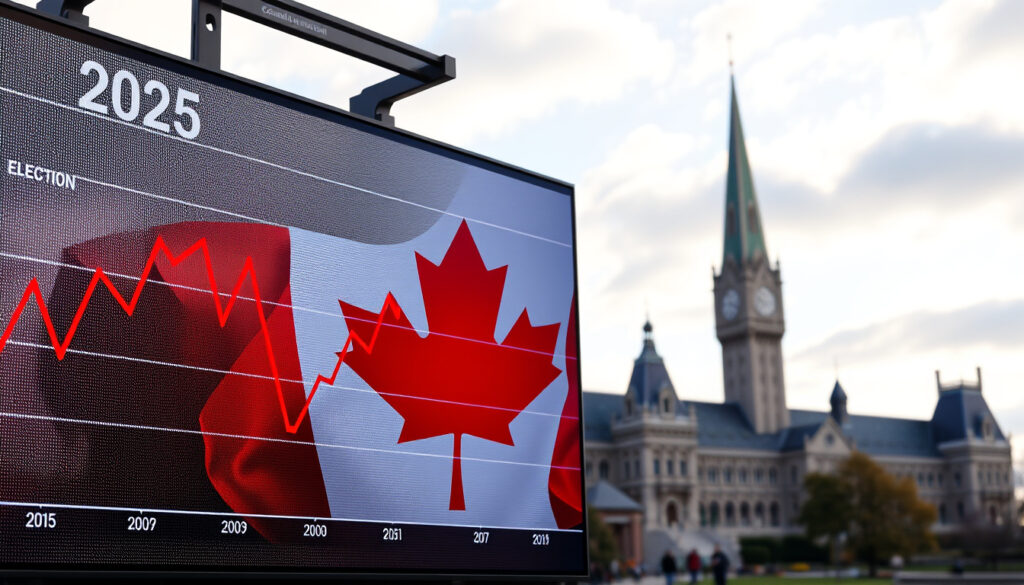
In early 2025, Canada’s Conservatives held a commanding lead — as much as 15 points ahead of the Liberals in some polls. By late April, the race had flipped entirely, with multiple trackers showing Mark Carney’s Liberals edged ahead of Pierre Poilievre’s Conservatives by a handful of points. The April 28, 2025 election capped one of the most dramatic polling reversals in recent Canadian political history.
Election Date: April 28, 2025 · Latest Nanos (April 27): LPC 42.6%, CPC 39.9% · Key Pollsters: Nanos, Ipsos, Leger
Quick snapshot
- Election held April 28, 2025 (Elections Canada)
- 11,054,046 voters cast ballots on election day (Elections Canada)
- 7,505,971 advance poll voters (Elections Canada)
- Exact final seat distribution remains contested across projections
- Voter turnout percentage not finalized at time of writing
- CBC Poll Tracker specific model assumptions not publicly detailed
- Conservatives opened 2025 at 47% vs Liberals at 20% per Nanos (Nanos Research)
- Race tightened to within a handful of points by April 26–27 (Nanos Research)
- Post-election analysis will reveal accuracy of late-stage projections
- Impact of US-Canada tensions on future polling trends remains to be seen
| Label | Value |
|---|---|
| Election Date | April 28, 2025 |
| Polling Start | After 2021 election |
| Key Aggregator | CBC News Poll Tracker |
| Regional Data | 338Canada polls |
| Ipsos Hub | Canada 2025 Election Polling |
What are the latest federal opinion polls in Canada?
Canada’s federal polling landscape in 2025 was dominated by three major trackers: Nanos Research, Ipsos, and Leger. The Wikipedia polling table aggregates results from all three, creating a comprehensive picture of where voters stood leading up to April 28.
National aggregates
The final stretch of polling showed a remarkably tight race. Nanos Research’s rolling poll ending April 27, 2025 put the Liberals at 42.6% versus the Conservatives at 39.9% — a 2.7-point Liberal lead (Wikipedia Polling Table). Ipsos, polling for Global News the same week, showed Liberals at 41% and Conservatives at 38% (Ipsos Canada). Leger’s April 25 survey put the Liberal lead at 4 points (43% to 39%) (Wikipedia Polling Table).
Recent poll dates
Research Co. released a poll on April 27 showing Liberals at 44% and Conservatives at 39% — the widest Liberal lead in the final days before voting (Wikipedia Polling Table). Liaison Strategies, polling April 26, showed a tighter 3-point gap (44% to 41%) (Wikipedia Polling Table). Mainstreet Research’s April 23 survey put Liberals at 43% versus Conservatives at 40% (Wikipedia Polling Table).
What is the Nanos poll for Canada today?
Nanos Research operates Canada’s most visible daily rolling tracker, releasing data throughout the campaign. Their methodology combines nightly telephone sampling with online panels, creating a near-real-time picture of voter sentiment.
Latest Nanos results
Nanos tracking ending April 26, 2025 showed the Liberals at 43.0% versus the Conservatives at 38.9% — a 4.1-point lead (Nanos Research). By April 23, the same tracker showed a tighter 3.6-point margin (LPC 42.9%, CPC 39.3%) (Nanos Research). The April 20 numbers were even more dramatic: Liberals at 43.7% versus Conservatives at 36.3% — a 7.4-point lead (Wikipedia Polling Table).
Trends over time
The trajectory was striking. January 31, 2025 data showed Conservatives at 41.6% versus Liberals at just 26.2% — a 15.4-point Conservative advantage (Wikipedia Polling Table). February numbers remained bleak for the Liberals: February 21 showed the CPC leading by 3.6 points (36.9% to 33.3%) (Wikipedia Polling Table). The reversal accelerated through March and April.
Nanos itself noted that 2025 opened with the Conservatives at 47% and Liberals at just 20% — a gap that seemed insurmountable at the time (Nanos Research). By late April, “less than a handful of percentage points separated the two front running parties” (Nanos Research).
What are the latest federal opinion polls for 2025?
Looking at the full arc of 2025 polling reveals a campaign defined by dramatic volatility. Ipsos, Leger, and Nanos all captured the same pattern from different angles.
Polling from 2021 to 2025
Ipsos data from February 3, 2025 showed the Conservatives at 41% versus Liberals at 28% — a 13-point CPC lead (Wikipedia Polling Table). Leger’s February 17 survey put the CPC at 41% and LPC at 33% — an 8-point gap (Wikipedia Polling Table). The NDP, meanwhile, hovered between 16-17% in early 2025, before dropping to 7-10% by April.
Key shifts
The reversal was driven by multiple factors. Ipsos found that cost of living was the top concern at 23%, followed by international relations at 15% — a category that jumped 11 points amid rising US-Canada tensions (Ipsos Canada). Mark Carney’s entry as Liberal leader brought a 4-point gain in Ipsos polling, with the party reaching 42% (Ipsos Canada). One in two non-Liberal voters cited track record as their reason for not supporting the Liberals (Nanos Research), suggesting economic management remained a vulnerability even as the race tightened.
The NDP’s collapse from 16-17% to 7-10% became a decisive factor, as Liberal gains drew heavily from former NDP supporters in the closing weeks.
What is the Leger poll for Canada today?
Leger, one of Canada’s largest independent polling firms, provided consistent measurements throughout the campaign cycle with both national and regional breakouts.
Leger latest findings
Leger’s April 25, 2025 poll showed the Liberals at 43% versus the Conservatives at 39% — a 4-point lead (Wikipedia Polling Table). Earlier Leger data from February 17 showed a very different picture: CPC at 41%, LPC at 33%, NDP at 11% (Wikipedia Polling Table). The 8-point swing in Liberal support between February and April mirrored patterns seen across other pollsters.
Comparisons to others
Leger’s numbers aligned closely with Nanos in the final week. Where Leger showed a 4-point Liberal lead on April 25, Nanos put the gap at 3.3 points two days earlier (LPC 41.9%, CPC 38.6%) (Wikipedia Polling Table). The consistency across methodologies lent credibility to the narrowing narrative heading into election day.
The implication: pollsters with fundamentally different methodologies converged on the same story, strengthening confidence that the race genuinely tightened rather than that measurement error created an illusion.
When is the next federal election in Canada?
The 45th Canadian federal election was scheduled for April 28, 2025, with advance polls running April 18-21. Elections Canada mobilized extensively: 492 offices opened and 230,000 staff hired to manage the process (Elections Canada).
Confirmed date
April 28, 2025 marked the fixed election date under Canada’s electoral calendar. Advance voting attracted 7,505,971 Canadians who cast ballots between April 18-21 (Elections Canada). On election day itself, 11,054,046 voters cast ballots at polling stations (Elections Canada).
Polling lead-up
The six weeks between mid-March and April 28 produced the most dramatic polling shifts of the campaign. Mainstreet Research’s April 15 survey showed a razor-thin 2-point Liberal lead (44% to 42%) (Wikipedia Polling Table). By April 23, Mainstreet had widened that to 3 points (43% to 40%) (Wikipedia Polling Table), while Nanos showed the tightest race of the entire cycle.
The pattern: the polling lead-up showed the race compressing from a double-digit Conservative advantage in February to a tight 3-5 point Liberal edge by late April. Consulteu les darreres enquestes i tendències per a les eleccions federals del Canadà del 2025 aquí: maplepolicy.org
| Pollster | Date | LPC | CPC | NDP | Lead |
|---|---|---|---|---|---|
| Nanos | January 31, 2025 | 26.2% | 41.6% | 17.3% | CPC +15.4 |
| Ipsos | February 3, 2025 | 28% | 41% | 16% | CPC +13 |
| Leger | February 17, 2025 | 33% | 41% | 11% | CPC +8 |
| Nanos | April 20, 2025 | 43.7% | 36.3% | 10.7% | LPC +7.4 |
| Leger | April 25, 2025 | 43% | 39% | 8% | LPC +4 |
| Nanos | April 26, 2025 | 43.0% | 38.9% | 8.0% | LPC +4.1 |
| Ipsos | April 27, 2025 | 41% | 38% | — | LPC +3 |
| Nanos | April 27, 2025 | 42.6% | 39.9% | 7.8% | LPC +2.7 |
Eight polls from three major trackers show the scale of the reversal: a 13-15 point Conservative lead in early 2025 transformed into a 3-5 point Liberal edge by election week.
Upsides
- Election date confirmed well in advance, allowing voters to plan
- Multiple independent pollsters provided transparent, verifiable data
- Advance polling reached over 7.5 million voters
Downsides
- Final seat projections remained contested across different models
- CBC Poll Tracker methodology not publicly detailed
- Constituency-level polling limited to select ridings
Liberals Poised to Win Fourth Term On the eve of the 45th Canadian federal election.
— Ipsos Canada
Less than a handful of percentage points separates the two front running parties on the tracking ending the Saturday before election day.
— Nanos Research
Race Tightens Further as Campaign Hits Final Stretch: Conservatives (38%, +2) Close in on Liberals (41%, -1).
— Ipsos Canada
For Canadian voters, the implications are tangible: whoever forms government will do so having won a race that defied predictions from just three months earlier. The polling reversal suggests Liberal support proved far more elastic than anticipated, while the NDP’s collapse raised questions about the party’s future direction after losing significant ground in urban ridings.
What factors influence Canadian federal polls?
Polling results are shaped by sampling methodology, question wording, timing relative to campaign events, and the composition of likely voters versus decided voters. Economic conditions, party leadership changes, and international relations — particularly US-Canada dynamics — all showed measurable impact in 2025.
How reliable are opinion polls for elections?
Modern election polls typically carry a margin of error of 2-3 percentage points. When multiple trackers show consistent patterns — as they did in late April 2025 — confidence in the overall direction increases, even if exact margins remain uncertain.
Which pollster has the best track record?
Canada’s major pollsters — Nanos, Ipsos, and Leger — all maintain strong track records, though each uses different methodologies. Nanos employs nightly rolling tracking, while Ipsos and Leger use periodic surveys. In 2025, all three converged on similar trends, lending credibility to the overall picture.
What are the current seat projections?
Seat projections vary by model. Aggregators like CBC and 338Canada use different weighting systems, producing slightly different outcomes. At the time of writing, exact seat counts remained contested, with projections ranging depending on regional swing assumptions.
How do polls differ by province?
Regional breakouts showed Liberals holding commanding leads in Ontario and Quebec, while Conservatives maintained strength in the Prairies and parts of Atlantic Canada. British Columbia emerged as a battleground where Liberal gains threatened to take NDP seats.
When do polls get finalized before election day?
Most pollsters release their final surveys 24-48 hours before polls close. In 2025, the last major releases came April 26-27, with Nanos tracking through the Saturday before election day.
What margins of error apply to these polls?
A typical national poll with 1,500 respondents carries a margin of error of approximately ±2.5 percentage points at the 95% confidence level. This means a 3-point lead is within the margin of error — a race described as “too close to call” statistically.
Related reading: Carbon tax rebate dates 2025
youtube.com, en.wikipedia.org, 338canada.com, mainstreetresearch.ca
Latest Nanos, Ipsos, Leger, and CBC Tracker data showing Liberals ahead by 3-5 points align with latest polls and projections for the April 28 vote.
More related posts
 What Is a Wireframe? Complete Guide to UX/UI Design
 Costco St. John’s NL: Address, Hours & Membership Guide
 Millie Bobby Brown Boyfriend: Jake Bongiovi Profile & Timeline
 Beer Stores Closing in Ontario 2026: Why, Where & What’s Next
 BBL Before and After: Real Photos, 6 Months to 10 Years Results
 Chick-fil-A Brampton – Address, Hours and Location Guide
 Kijiji Ottawa Free Stuff: Listings, Tips and Finds
 Waffle Daily Word Game: Rules, Variants, Play & Tips